

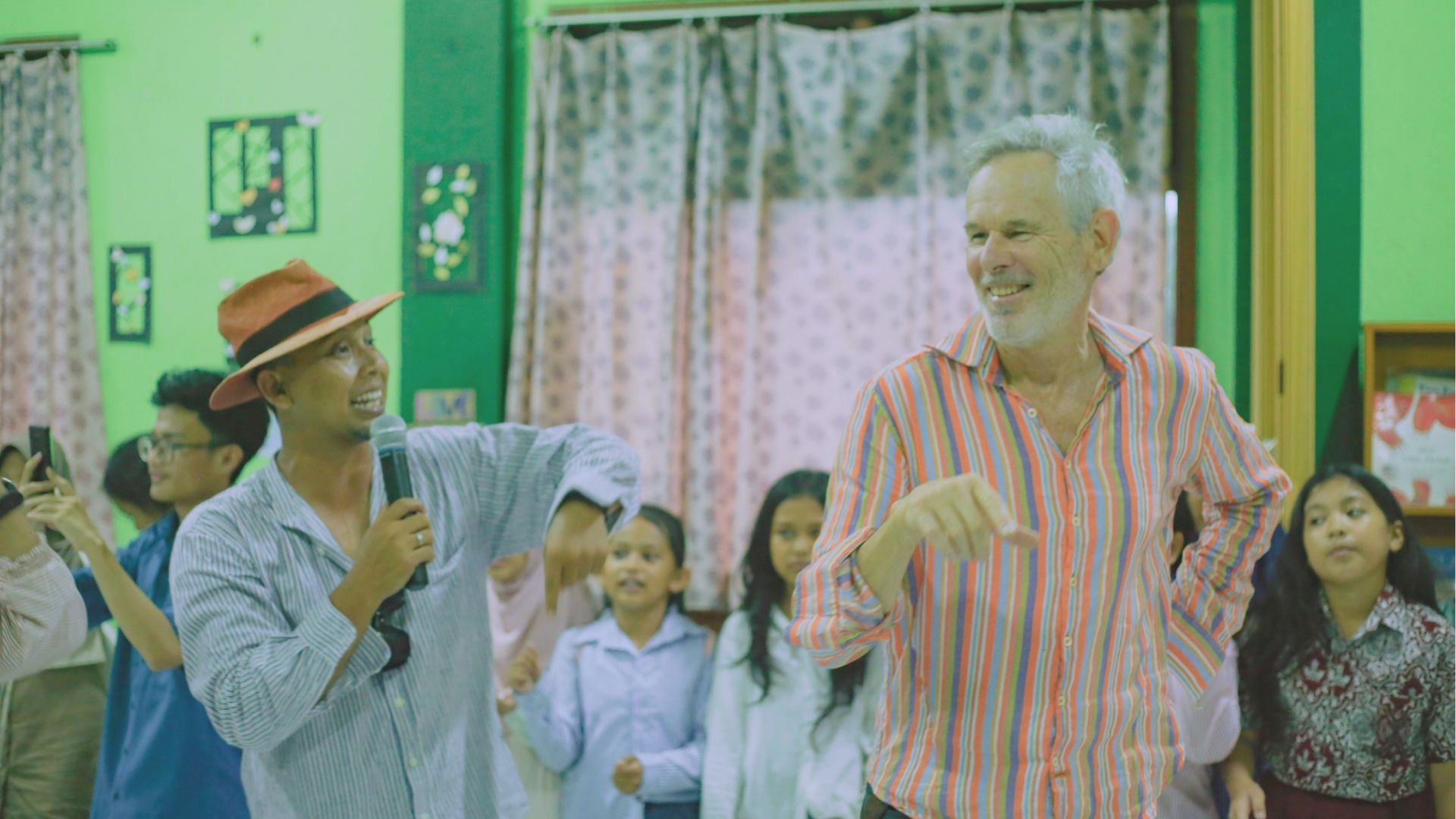
The classroom felt different that afternoon.
On April 15, 2026, the students of Yayasan Cipta Mandiri (YCM) gathered not for a lesson, but for a farewell. There were performances — dances, songs, and a short drama that retold six months of shared memories in the most honest way possible: with laughter and tears mixed together. The room was full of color, energy, and something else that is hard to name. It was the kind of feeling that only comes when you realize that someone has quietly changed your life, and now they have to go.
That someone was Pak Anton — a volunteer from Australia who had spent six months walking alongside the students and staff of YCM, not as a distant expert, but as a fellow human being willing to learn and to teach at the same time.


A Stranger Who Became Family
When Pak Anton first arrived at YCM, he came from a world very different from the narrow streets of Bogor. A different continent, a different culture, a different rhythm of life. Yet from the beginning, he chose not to stand apart. He observed. He listened. He adapted.
YCM is not a traditional school. It is, as its founders described it, a rumah pembinaan — a house of growth — where children and youth from underprivileged backgrounds aged 10 to 22 come not just to learn, but to discover who they are. Established in 2002 by Mrs. Gesine Nitzschke and Ms. Putu Ayu Novitry Ariany, YCM was built on values of mutual trust, responsibility, teamwork, and creativity. It is a place where confidence is treated as a skill — something that can be learned, practiced, and earned through small, honest steps.
Into this world, Pak Anton arrived with his own set of tools — and the wisdom to know when to use them.


The Lessons Between the Lessons
He did not only teach. He demonstrated.
One of his most consistent reminders was something he called CCQ — a simple technique for checking whether a message had truly landed, whether the listener had genuinely understood. For the staff and tutors at YCM, this was more than a classroom method. It was a new way of thinking about communication itself: not just about speaking, but about connecting.
He also had a quiet, almost gentle way of redirecting when someone was moving too fast. “Slow it down,” he would say — not as a criticism, but as an invitation to be present. To give the moment the space it deserved. For a team that works with young people navigating real and difficult lives, this was a lesson that reached far beyond any lesson plan.
And then there was his greeting — warm, consistent, and impossible to forget. “Nice to see your smiling face,” he would say, every time. It sounds simple. But for students who have not always been told that their presence matters, those five words carried real weight.
What Pak Anton gave to YCM was not just knowledge. He gave the staff the confidence to become better tutors. He showed them how to handle difficult moments in a session — not with rigid formulas, but with flexibility and human judgment. He modeled what it looks like to be both structured and kind. To know when to hold the method, and when to follow the moment.


Small Rituals, Big Memories
Not every important lesson happens inside a classroom.
Some of the warmest memories Pak Anton left behind have nothing to do with workshops or techniques. On more than a few occasions, he would treat the team to bubur ayam — a warm, simple bowl of Indonesian chicken porridge from a passing street vendor. It was not a grand gesture. But it was the kind of gesture that stays.
Now, whenever the familiar call of a tukang bubur echoes through the street, someone will smile and say his name. That is the quiet kind of legacy that does not appear in any report, but lives on in the everyday.


The Weight of a Real Goodbye
The farewell event on April 15th was, by every honest account, both proud and heartbreaking.
The students gave everything they had. They danced. They sang. They performed a drama about Pak Anton’s journey — funny in some moments, deeply moving in others — and the room filled with something that felt rare: the kind of tears that come not from sadness alone, but from gratitude.
A stranger had become familiar. A visitor had become family. And now, as it always goes, time — the same force that had brought them together and helped them understand each other — was gently asking them to let go.
There is a truth that YCM knows well, one that lives in the heart of every student who has ever said goodbye to someone who mattered: semakin dekat pertemananmu, semakin berat perpisahanmu. The closer the friendship, the heavier the farewell.


What Stays When Someone Leaves
Pak Anton has returned to Australia now. But the things he left behind cannot be packed into a suitcase.
They live in the way a tutor now pauses before moving on, to ask if everyone truly understood. They live in the confidence of a staff member who once doubted their own ability to guide others. They live in the laughter of students who will always associate the sound of a street vendor with a kind man from far away who once treated them to breakfast and called them by their smiling faces.
This is what YCM has always believed: that growth does not require perfection, and that connection does not require sameness. It requires only the willingness to show up, to listen, and to care.
Pak Anton showed up. For six months, he cared deeply.
And YCM — its students, its staff, its story — is richer for it.
If you believe in the power of human connection to change lives, consider being part of YCM’s journey — as a donor, a volunteer, or simply someone who shares our story. Every small act of support helps a young person take one more step forward.